
 Ammar Zakareya Ali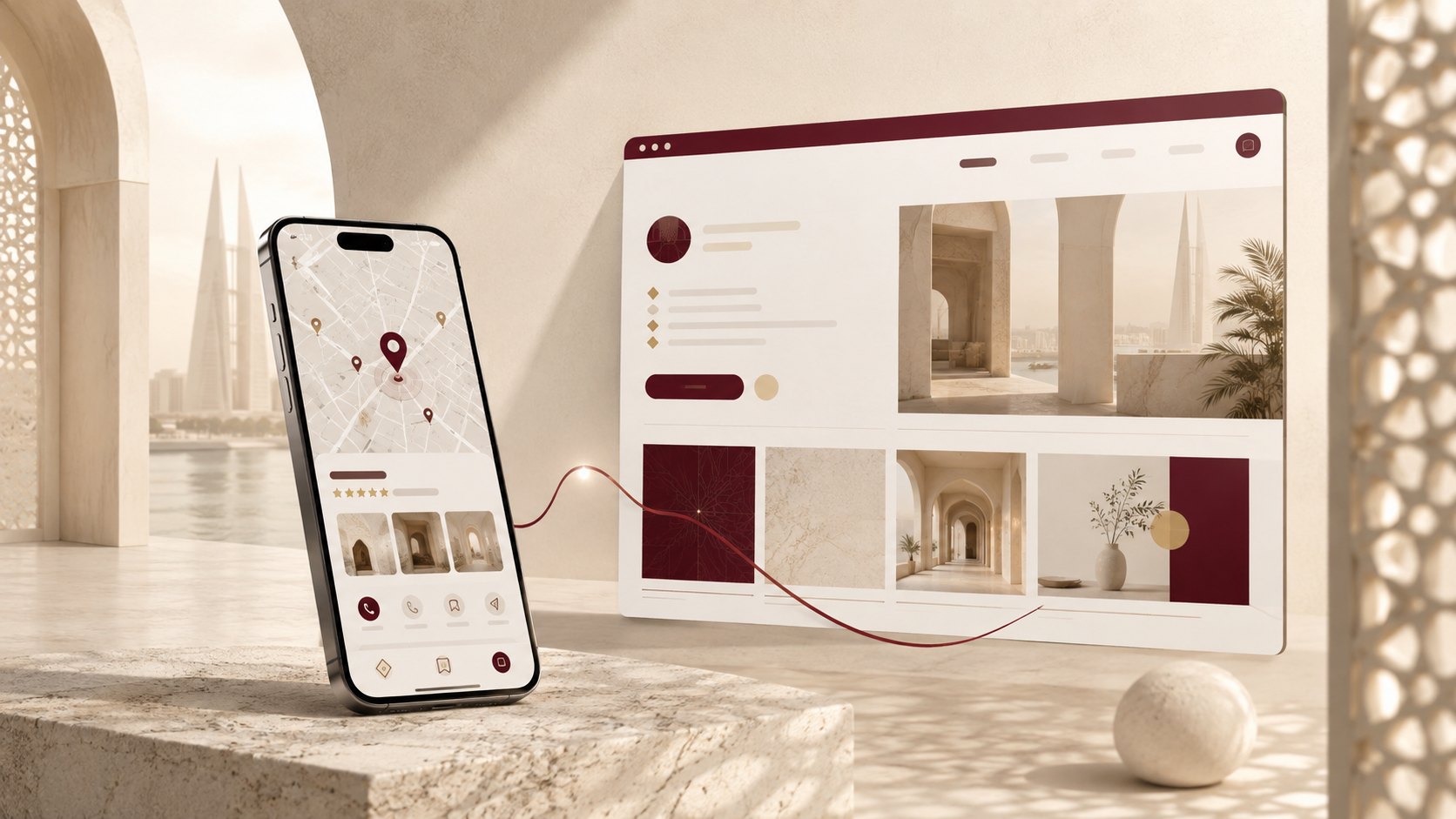
One connected decision system
For many customers, the journey to choosing a business begins with a local Google search.
They may discover your company through a map result, review your photos and ratings, visit your website, compare your services and then decide whether to call, message or continue searching.
That entire experience can happen in a few minutes.
Yet many businesses manage their website and Google Business Profile as separate channels. The information does not always match. Services are described differently. Important pages are difficult to find. The website may look polished, but it does not continue the journey that started on Google.
A stronger approach is to treat both as parts of one connected decision system.
02 / The customer sees one journey
Every stage either builds confidence or creates hesitation.
A customer does not separate your profile, website, SEO and contact options. They see one business and one path towards a decision.
- 01
Search
A customer looks for a service nearby.
- 02
Discover
Your business appears in Google Maps.
- 03
Reassure
They review your rating, location and photos.
- 04
Understand
Your website answers the deeper questions.
- 05
Enquire
A clear next step turns interest into action.
The objective is not simply to be visible. It is to make the next step feel clear and trustworthy.
Discovery and reassurance
What your Google Business Profile should do
Your profile acts as a concise introduction. It should help potential customers quickly understand:
- 01
What your business does
- 02
Where you are located
- 03
Whether you serve their area
- 04
When you are available
- 05
What other customers say about you
- 06
How they can call, message, request directions or visit your website
It should provide enough confidence for the customer to continue, but it cannot communicate the full value of your business.
Depth and decision support
What your website should do
Your website explains your services, demonstrates your experience and answers the questions that cannot be answered inside a map listing. That is why a considered website strategy matters before pages are designed.
- 01
Which service is right for them
- 02
What makes your approach different
- 03
Who they will be dealing with
- 04
What experience or evidence supports your claims
- 05
What they should expect after making contact
- 06
What action they should take next
The website should develop the story and move the customer closer to an informed enquiry.
03 / Example of a connected sitemap
A search result should lead into a page structure built for the decision.
This simple blueprint shows how a local search journey can move from a Google profile into focused information, proof and a clear way to make contact.
Visibility earns attention. Clarity and trust help turn that attention into action.
03 / Where the journey commonly breaks
The handover from Google to the website is where confidence is often lost.
Inconsistent information
The address, telephone number, opening hours or service details differ between the website and the Google profile. This creates uncertainty and can make customers question which information is current.
A generic homepage
The homepage describes the company broadly but does not help visitors find the specific service they searched for. Each search should continue towards relevant information.
Weak service pages
A short paragraph and a stock image rarely provide enough confidence for an important decision. Useful service pages explain the problem, the service, the process, the evidence and the next step.
Poor mobile experience
Many local searches happen when the customer wants to act quickly. Small text, crowded sections, difficult navigation and unclear contact buttons introduce unnecessary friction.
No clear next action
The website provides information without helping the visitor understand what to do next, whether that is calling, sending a WhatsApp message, requesting a consultation or asking for directions.
04 / How to build a connected system
Make each part of the journey support the next.
The strongest local experience is built through consistent language, focused pages, clear location relevance, mobile clarity and ongoing measurement.
- 01
Use consistent service language
The services listed on Google should match the terminology used on the website. Customers should immediately recognise that they have reached the right business.
- 02
Create focused service pages
Important services need dedicated pages with enough information to support a decision and give search engines clear context about what the business offers.
- 03
Connect the business to its location
Location and service area information should be clear and consistent, without creating repetitive pages that add little value for the customer.
- 04
Design for mobile intent
Contact options, directions, service information and essential proof should be easy to find without forcing the visitor through unnecessary steps.
- 05
Measure what happens after discovery
Review which pages people visit, which actions they take and where they leave. Improve the experience using real behaviour rather than assumptions.

05 / A practical review checklist
Review your website and Google Business Profile together.
If several answers are unclear, the problem may not be a lack of marketing activity. The customer journey itself may need to be improved.
Do the business name, telephone number, address and opening hours match?
Are the most important services clearly represented in both places?
Does each major service have a useful page?
Can a mobile visitor contact the business easily?
Are reviews, credentials, project examples or other trust signals visible?
Does the website answer the questions customers commonly ask?
Is the next action clear on every important page?
Are the website and profile reviewed and updated regularly?
06 / Ongoing improvement
A website is not a finished brochure.
A business website should continue to develop as customer needs, services and search behaviour change.
The strongest results come from connecting a strategically structured website, accurate local visibility and ongoing measurement and improvement.
This creates a digital presence that is easier to find, easier to trust and easier to choose.
Request a strategy session